
What are the bathroom color trends for 2026 in Chicago homes?
The bathroom color trends 2026 come down to a few clear moves we are seeing in Chicago remodels this year: warm, grounded neutrals replacing the cool grays that dominated the last decade, earthy greens and soft clay tones used as accents, deeper and more saturated vanity colors set against lighter walls, and warmer metal finishes that read as color rather than hardware. The through line is warmth. After years of gray-on-gray builder baths, Chicago homeowners are choosing palettes that feel calm and lived-in instead of clinical.
Two of the industry color announcements point the same direction. Sherwin-Williams named Universal Khaki SW 6150 its 2026 Color of the Year, a warm greige, and Benjamin Moore named Silhouette AF-655, a deep warm charcoal, its 2026 Color of the Year. One is a soft mid-neutral and the other is a moody anchor, and in a bathroom they tend to get used together: warm neutral on the walls, a saturated tone on the vanity or a single feature wall.
At a glance: the 2026 bathroom trends we're seeing
Warm neutrals over cool gray. Greige, mushroom, and soft taupe are replacing the blue-gray baths of the 2010s.
Earthy green and clay as accents. Sage, olive, and terracotta show up in tile, paint, and vanities, rarely wall-to-wall.
Deeper, bolder vanity colors. The vanity is where people take the color risk, in forest green, navy, and warm wood tones.
Warm and mixed metals. Brass and champagne finishes read as an accent color, often paired with a cooler metal.
Light and airy for small condo baths. Compact Chicago bathrooms lean on tonal, light palettes to keep the room from closing in.
The 2026 palette shift: warm neutrals over cool gray
If your bathroom was built or last remodeled between roughly 2008 and 2020, it is probably some version of cool gray with white trim. That look is what 2026 is moving away from. The replacement is a warmer neutral base, a greige or soft taupe, that reads clean in the morning and cozy at night. Chicago light is the reason this matters more here than in a sunnier market. Our winters are long and gray, and north-facing city bathrooms with a single small window can turn a cool paint color flat and cold from November through March. Warm neutrals push back against that.
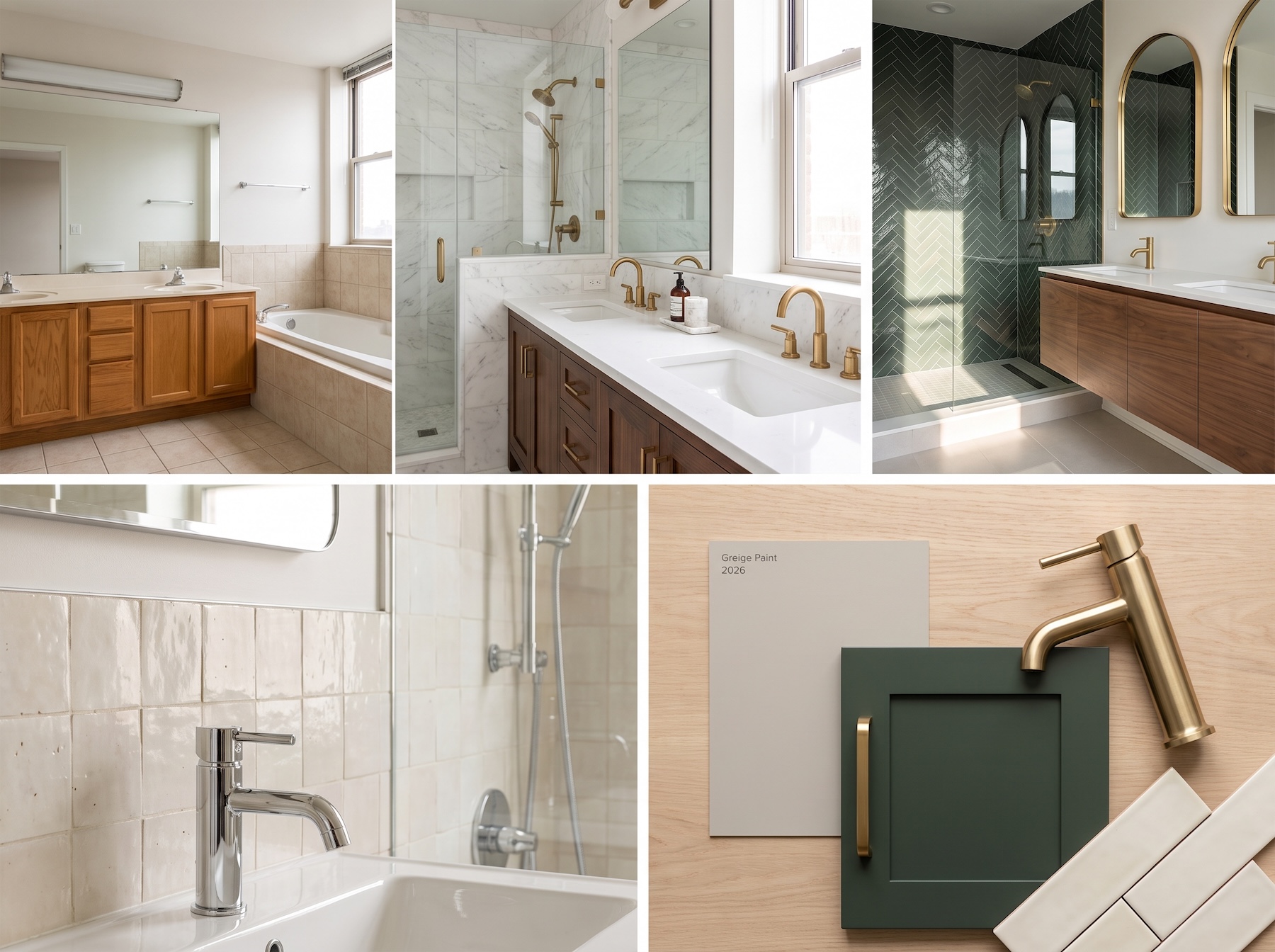
On a recent South Loop condo project we remodeled two early-2000s bathrooms that were the textbook example of a dated palette, all beige builder-grade tile and honey-oak vanities. Rather than chase another trend gray, the design leaned warm and timeless: polished Carrara marble in soft white and gray for the primary bath, a semi-custom vanity, and a warmer neutral overall scheme. The lesson from that job applies to almost any Chicago bath. A warm, restrained base ages far better than a trend-driven cool tone, and it keeps the room from feeling like it needs another remodel in five years.
Bathroom vanity color: where 2026 gets bold
The vanity is the single best place to make a color statement, and it is the clearest bathroom vanity color trend of 2026. Walls stay neutral, and the vanity carries the personality. The colors we are specifying and installing most this year are forest and olive green, deep navy, warm walnut and white-oak wood tones, and the occasional soft clay or muted black. A painted vanity in a saturated color against a warm neutral wall is a low-risk, high-impact move, because paint and door fronts are far easier to change later than tile.
Green in particular has staying power in Chicago because it pairs naturally with the brass and wood tones people already want. On a South Loop modern bathroom we completed in a townhome, green herringbone tile in the shower set the tone for the whole room, carried by a floating vanity and arched mirrors. When a vanity is the color anchor, the material and build quality matter as much as the color itself. A custom or semi-custom cabinet in a durable painted or wood finish holds up to Chicago humidity swings far better than a big-box unit, which is why vanities are one of the most common requests in our custom carpentry and built-ins work.
Tile color in 2026, not tile type
This post is about color, not tile selection, so a quick callout: if you are trying to choose a tile material, shape, or layout, read our full guide to the best tile for Chicago bathrooms. On color alone, 2026 tile is following the same warm-and-earthy story as paint. Crisp bright white is giving way to warmer whites, soft creams, and greige, and colored tile is showing up as a deliberate accent rather than a full-room commitment.
Green is the standout accent color in tile this year, from sage to deep forest, which is exactly why the green herringbone in that South Loop shower reads as current rather than trendy. On a Wicker Park primary suite conversion, we used zellige tile as an accent, and the appeal of zellige is largely a color story: the handmade glaze gives a single color subtle variation and depth that a flat, uniform tile cannot. Terracotta and warm clay tones are the other color to watch, usually in a niche, a shower floor, or a single feature area rather than across every wall.
Fixtures and metal finishes as color accents
In 2026, metal finish is a color decision, not just a hardware choice. The all-chrome or all-polished-nickel bathroom is giving way to warmer metals and intentional mixing. Brass and champagne bronze are the headline finishes, and they behave like an accent color: warm, reflective, and enough on their own that the rest of the palette can stay quiet.
Which finish is right depends on the palette you have chosen. On that South Loop primary bath, Kohler brass fixtures were the warm accent that carried the Carrara marble, and matching brass in the guest bath tied the two rooms together. In the Wicker Park primary suite, the palette called for chrome instead, which kept the zellige and the soaking tub at the windows feeling fresh and light rather than heavy. Both are correct. Warm metals suit warm-neutral and green schemes, while polished chrome or nickel keeps a cooler, brighter bath crisp. If you mix metals, keep it to two and let one lead, usually a warm metal on the faucets and lighting with a cooler metal on glass hardware.
Small-bathroom color strategy for Chicago condos
Most Chicago bathrooms are not spacious primary suites. They are compact condo baths, often 40 to 70 square feet, with one small window or none. Color strategy in that space is about keeping the room open. The reliable approach is tonal: a light warm neutral on the walls, similar tones in the tile and vanity, and one accent, whether a green vanity, a brass fixture, or a colored niche, so the room has a focal point without feeling boxed in. These light, layered primary bathroom color palettes make a small footprint feel larger, where a dark all-over color in the same space would close it in.
Here is the part that matters most for condo and high-rise owners: color is one of the very few remodel decisions you can make without board approval. Paint, a repainted or replaced vanity, new mirrors, and updated fixtures usually fall well inside what a condo owner can do without a formal review, unlike anything that touches plumbing, the building stack, or shared walls. That makes a color-led refresh the highest-impact, lowest-friction update available to most Chicago condo owners. If your project does go further into a full bathroom remodel, our high-rise bathroom remodeling guide covers the building logistics, and our condo bathroom remodel cost guide covers what the work actually runs in Chicago. Larger scopes fall under our condo renovation and bathroom remodeling services.
Color Is the Easy Part of a Chicago Bathroom Remodel
A palette only works when the work behind it is right. Beyond bathrooms, Wood Contracting handles kitchen remodeling, whole home renovation, and basement finishing, so a color direction you love in the bathroom can carry through the rest of your home with the same finish quality. Whether it is a single condo bath or a full-floor project across South Loop, Wicker Park, or anywhere in the city, we tie the palette to real materials, real Chicago light, and a real budget.
Bathroom color trends 2026: frequently asked questions
What is the most popular bathroom color for 2026?
Warm neutrals lead in 2026, specifically greige, soft taupe, and warm white, replacing the cool grays of the last decade. Sherwin-Williams and Benjamin Moore both named warm 2026 Colors of the Year, and in Chicago these warmer tones hold up much better under long gray winters than cool blue-grays.
What is the best bathroom vanity color right now?
Deep saturated colors are the strongest bathroom vanity color trend of 2026, led by forest and olive green, deep navy, and warm wood tones like walnut and white oak. Keeping the walls neutral and putting the color on the vanity is a low-risk way to make a statement, since a vanity is far easier to repaint or replace than tile.
Is gray out for bathrooms in 2026?
Cool, blue-toned gray is fading, but warm greige and mushroom tones are very much in. The shift is toward warmth rather than away from neutrals entirely, so a warm gray still works while a stark cool gray now reads dated.
What metal finish is trending for bathrooms in 2026?
Warm metals lead in 2026, especially brass and champagne bronze, and intentional mixing of two finishes is common. Warm metals pair naturally with the green and warm-neutral palettes trending this year, while polished chrome and nickel still suit cooler, brighter bathrooms.
Can I change my condo bathroom color without board approval?
In most Chicago condo buildings, color changes like paint, a repainted or replaced vanity, new mirrors, and updated fixtures fall inside what an owner can do without a formal board review. Anything that touches plumbing, the building stack, or shared structure is different, so confirm your association rules, but a color-led refresh is usually the lowest-friction update available.
What colors make a small Chicago bathroom look bigger?
Light, tonal palettes make a compact bathroom feel larger, using a warm neutral on the walls with similar tones in the tile and vanity and just one accent for a focal point. A single dark all-over color in a small windowless condo bath tends to close the room in instead.