

How Do You Choose the Right Vanity, Mirror, and Sink for a Chicago Bathroom?
The right bathroom vanity, mirror, and sink come down to three things, in this order: how much usable floor space and plumbing you actually have, how the bathroom gets used every day, and the look you want to live with for the next fifteen years. In a Chicago condo, where the footprint is tight and the drain ties into a shared plumbing stack, those constraints decide more than any showroom photo. Choose the three pieces as one connected set and a small bathroom can feel custom. Treat them as three separate shopping trips and they rarely line up.
We make these calls constantly on bathroom remodeling jobs across the city, from high-rise units in Streeterville and the Gold Coast to vintage two-flats and townhomes. The fixtures that work in a 1990s River North tower are not always the ones that work in a Lincoln Park graystone, and the difference usually comes down to wall depth, plumbing location, and how the door swings. Here is how to think through each piece.
How Do You Choose a Bathroom Vanity for a Chicago Condo?
Start with the vanity, because it sets the plumbing, the counter, and the storage for the entire room. For most Chicago condo bathrooms, a floating (wall-mounted) bathroom vanity is the strongest choice: it exposes floor area so a small room reads larger, it gives flexibility on outlet and drain height, and it makes cleaning the floor far easier. Floating vanities are the single biggest bathroom furniture trend right now, and in tight city footprints they earn it.
Floating, freestanding, or furniture-style?
Floating vanities mount to the wall and read modern and light. Freestanding vanities sit on the floor, hide more plumbing, and deliver maximum storage. Furniture-style vanities are a freestanding subset with legs and fluted or paneled fronts that look more like a credenza than a bath cabinet, and they are having a real moment in 2026.
Building type should steer the choice. In a vintage Chicago home with plaster walls that are rarely plumb, a freestanding or furniture-style vanity is more forgiving than a floating one, which telegraphs every dip in an out-of-level wall and needs blocking added inside the wall to carry its weight. In newer condos with sound framing, floating units install cleanly and look the part.
Should you choose a single or double vanity?
Only go double if you genuinely have the wall and the plumbing for it. A double vanity needs roughly 60 inches of wall to feel right; below that, a single bowl with more usable counter beats two cramped basins. In a condo, a second sink also means a second drain tied into the same stack, which is not always simple or cheap.
On a Wicker Park primary suite we built out of a former fifth bedroom, a double quartz vanity made sense because the room had the width and we were already running new plumbing. In a standard high-rise hall bath, that same double vanity would crowd the room and complicate the stack connection. Match the configuration to the room, not to a picture you saved.
What vanity material and finish holds up in Chicago?
Wood tones are leading, and not just in showrooms. Wood-faced vanities have overtaken painted ones, with 62% of designers naming wood versus 53% for painted in the 2026 NKBA KBIS Bath Trends Report. Homeowners are choosing the same: wood is the No. 1 vanity finish at 26%, just ahead of white at 22%, in the 2025 U.S. Houzz Bathroom Trends Study.
The catch in Chicago is humidity. A condo bathroom with one weak exhaust fan runs steamy, and cheap veneer will peel at the edges within a few years. Specify a plywood (not particleboard) cabinet box, sealed solid wood or a quality thermofoil rated for wet areas, and seal any exposed underside. More than half of homeowners now go custom or semi-custom for exactly this reason: 55% chose a fully custom (33%) or semi-custom (22%) vanity in that same Houzz study. Our custom carpentry and built-ins shop builds vanities sized to the inch, which matters when a condo wall measures 53 inches and stock comes in 48 or 60.
On a South Loop modern bathroom remodel, a floating vanity paired with arched mirrors did the heavy design lifting while the layout stayed put, so the budget went into materials instead of moving walls. On a separate South Loop multi-bathroom project, a semi-custom vanity let two dated builder-grade baths reach a high-end look without relocating a single drain. That refresh-in-place approach is often the smartest move in a condo renovation.
What Is the Best Bathroom Mirror for Your Space?
The best bathroom mirror is the largest one your wall and lighting can support, lit from the sides rather than straight overhead. For most Chicago bathrooms that means a backlit LED mirror or a mirror flanked by vertical sconces, both of which kill the harsh top-down shadows a single ceiling fixture throws across your face.
Backlit LED mirrors and lighted medicine cabinets
Backlit and LED mirrors are the dominant mirror trend heading into 2026. They give a soft, even glow, usually include anti-fog and dimming, and let you set the color temperature. For a home bathroom, choose a warm white around 2700K to 3000K; it flatters skin tone far better than the cool blue light builders default to. A lighted medicine cabinet folds storage and light into one unit, which is worth a lot in a storage-starved condo bath.
Shape and size
A round or arched mirror softens a room full of square tile and rectangular fixtures, which is why arched mirrors worked so well over the floating vanity on that South Loop bath. Over a double vanity, you can run one long mirror or a matched pair; the pair reads more custom and gives each user their own light. Whatever the shape, size the mirror to the vanity rather than the wall so it looks intentional.
Can you recess a medicine cabinet in a condo wall?
Not always, and this is worth checking before you buy. Interior, non-load-bearing stud walls usually accept a recessed cabinet. In many high-rises, though, the bathroom wall is concrete, carries the plumbing stack or ductwork, or is an insulated exterior wall, and none of those will take a recessed box. When recessing is out, a slim surface-mount cabinet, or a mirror paired with separate cabinetry, gets you the storage without opening a wall that cannot be opened.
Which Bathroom Sink Type Should You Choose?
Match the sink to how the bathroom is used. For a primary or family bathroom, an undermount sink is the workhorse: it mounts below the counter so you can wipe water straight in with no rim to trap grime, and it keeps the counter clear. Save the statement sinks for low-traffic powder rooms.
Undermount and integrated sinks for everyday bathrooms
Undermount sinks are the default for hard-working baths because they clean easily and pair cleanly with stone or quartz counters. Integrated sinks take it a step further: the bowl and counter are one molded piece with no seam to fail, which is excellent for kids' baths and condos where you want a surface that wipes down in a single pass. Both keep a tight footprint feeling clean and uncluttered.
Vessel, trough, pedestal, and wall-mount sinks
Vessel sinks are still in style in 2026, but they belong in powder rooms and guest baths where they can be the visual statement without taking daily abuse; they splash more and they raise the effective counter height, so check the ergonomics first. A trough or long basin suits a shared bath used by two people at once. Pedestal and wall-mount sinks free up visual space in a tiny half bath but give up all storage, so use them where you do not need a cabinet, not in a primary bath.
Match the sink to the counter and faucet
The sink, counter, and faucet have to be ordered as a set. A faucet drilled for a single hole will not fit a sink set up for a widespread, and a vessel sink needs either a tall vessel faucet or a wall-mounted one. Getting this wrong means re-drilling a stone counter or shipping fixtures back, a common and avoidable mistake we head off during selections.
How Do You Make the Vanity, Mirror, and Sink Work Together?
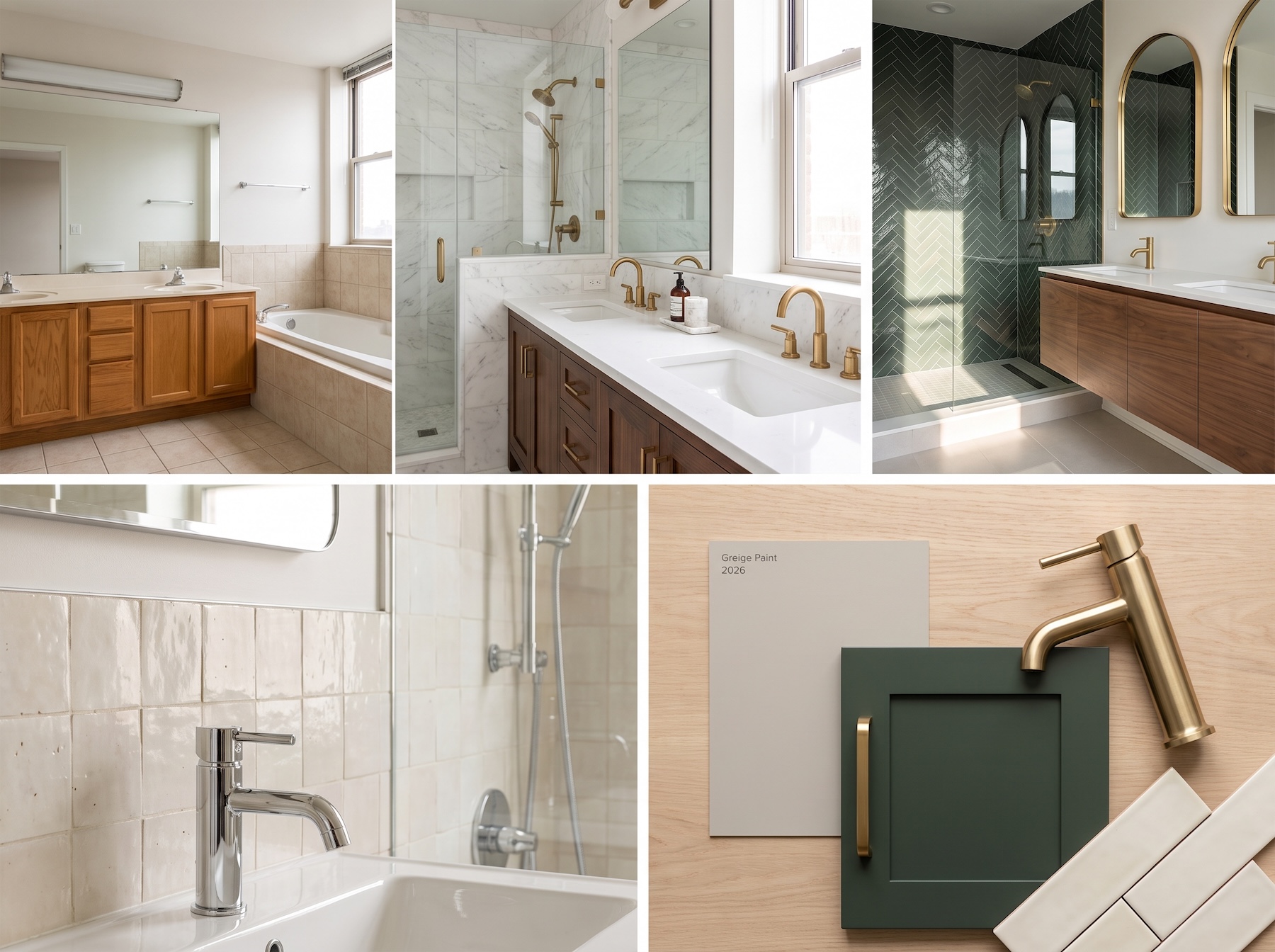
Pick one finish story and let the three pieces share it. Warm metals are winning over chrome: matte (54%), brushed (51%), and satin (46%) faucet finishes all outranked polished (39%) in the 2026 NKBA report. Mixing two metals is fine when it looks deliberate, for example a brushed-brass faucet with matte-black cabinet pulls, but more than two usually reads as an accident.
Scale ties it together. Center the sink on the faucet and the drain, size the mirror to the vanity, and hang it at a height that works for the people actually using the room. If you are remodeling more than one bath or doing a whole home renovation, repeat a finish or a wood tone across rooms so the home reads as one project. The cabinet logic even carries over from a kitchen remodeling job, since a vanity is really a kitchen cabinet with a sink in it, and a compact wall-mount sink with a simple framed mirror keeps a bathroom added during basement finishing from feeling like an afterthought.
A vanity, mirror, and sink chosen as a set, sized to the real room, and built for Chicago humidity will outlast any single trend. If you are weighing options for a condo or a vintage home and want a second opinion before you order, that is the kind of detail we work through on every bathroom remodeling project.
Frequently Asked Questions About Bathroom Vanities, Mirrors, and Sinks
Should I choose a floating or freestanding vanity for a small condo bathroom?
For most small condo bathrooms, choose a floating vanity. Exposing the floor underneath makes the room read larger and simplifies cleaning, and wall-mounting lets you set the height. The main exception is a vintage unit with out-of-level walls, where a freestanding vanity hides imperfections more gracefully.
Can I install a double vanity in a Chicago condo bathroom?
Sometimes, but only if you have about 60 inches of wall and can run a second drain into the building's plumbing stack. Below that width, a single sink with more counter is more useful than two crowded basins. In high-rise condos, the added plumbing work is usually the real cost driver, not the cabinet.
Are vessel sinks still in style in 2026?
Yes, vessel sinks are still in style in 2026, but they work best in powder rooms and guest baths rather than busy primary bathrooms. They make a strong design statement, though they splash more and sit higher, so confirm the counter and faucet heights before committing.
What is the best bathroom mirror for a small bathroom?
The best mirror for a small bathroom is the largest backlit LED mirror or lighted medicine cabinet your wall and lighting will support. Side light or backlight beats a single overhead fixture for flattering, shadow-free light, and a lighted medicine cabinet adds storage you cannot spare in a small condo bath.
Do recessed medicine cabinets work in condo walls?
Not always. Interior stud walls usually accept a recessed cabinet, but concrete walls, walls holding the plumbing stack or ductwork, and insulated exterior walls often will not. Confirm what is inside the wall before buying a recessed unit, or plan on a surface-mount cabinet instead.
How much does a bathroom vanity cost in Chicago?
A stock vanity is the least expensive option, a semi-custom vanity typically lands in the low-to-mid four figures installed, and a fully custom build runs higher depending on size, material, and counter. In condos, the bigger cost variable is usually the plumbing and any stack work, not the cabinet itself.