
Should You Remodel Now or Wait? Here Is What the Cost Data Says
If you are deciding whether to remodel now or wait, the honest answer for most Chicago homeowners is that waiting rarely makes the project cheaper. Remodeling costs have trended up for years, and the data heading into 2026 points to continued upward pressure, not relief. The real question is not whether prices will drop if you wait, but whether your household is ready and whether the scope is right. Below is what the numbers show, where the exceptions are, and how to control cost if you move forward with kitchen remodeling or bathroom remodeling.
A Decade of Remodel Costs, in One Number
The clearest signal comes from the 2025 U.S. Houzz & Home Study, which surveys hundreds of thousands of homeowners about what they actually spent. National median renovation spend per household nearly doubled from $13,000 in 2019 to $24,000 in 2023. It eased to $20,000 in 2024, and that is the number that tempts people to wait. The dip is worth understanding before you read it as falling prices.
The 2024 decline was driven by scope, not by remodels getting cheaper. When you isolate major projects, the cost of doing real work held firm or climbed:
Major remodels of large kitchens (200 square feet or more) held at a $55,000 median for three straight years, while the top tier of spend rose from $125,000 to $150,000. Major remodels of small kitchens rose 9 percent to a $35,000 median. Major remodels of large primary bathrooms held at a $25,000 median for three years, while the top tier climbed from $60,000 to $70,000. Major remodels of small primary bathrooms rose 13 percent to $17,000.
So the floor on a serious kitchen or bathroom remodel is steady and the ceiling keeps rising every year. The overall median fell only because more homeowners chose smaller, lighter projects in 2024. If you want the work most people picture when they say remodel, that work is not getting cheaper.
Why Waiting for Prices to Drop Rarely Works
Remodeling costs are built mostly from materials and labor, and both are still climbing. Construction material prices in 2025 averaged about 4.2 percent above 2024 levels, according to the Engineering News-Record cost report. Tariff policy in place at the start of 2026 is estimated to add roughly 6 percent to construction material costs versus a 2024 baseline, per analysis from Cushman & Wakefield, with the effect varying widely by material. On the labor side, the Associated General Contractors of America reports that the large majority of contractors still struggle to fill positions, which keeps skilled-trade wages firm.
Demand is not cooling enough to change that math. Harvard's Joint Center for Housing Studies projects national remodeling spend will keep growing into 2026, reaching roughly $522 billion, in its Leading Indicator of Remodeling Activity. The Houzz study found 52 percent of homeowners planned to renovate in 2025, and the single most common challenge they reported was finding the right contractor at 33 percent. A slow market would loosen schedules and soften pricing. That is not the market we are in.
What This Means in Chicago Specifically
Chicago projects typically run 15 to 25 percent above national averages because of our aging housing stock, strict building codes, and condo and HOA requirements that add coordination and time. The 2025 Cost vs. Value Report puts a major midrange kitchen remodel in the Chicago metro near $84,237, well above the national figure. Those local realities do not ease when you wait. If anything, an older Chicago building gives you more reasons to act, because deferred problems here tend to surface as water damage, failing original plumbing, and surprises behind plaster walls.
The Houzz data backs this up. Twenty-nine percent of renovating homeowners had a damaging event in the prior five years, with water damage from plumbing the most common at 14 percent, and median spend on plumbing-system work jumped 25 percent year over year. Waiting on a kitchen or bathroom that is already showing its age often means paying later for damage instead of paying now for the upgrade you actually wanted.
How to Control Cost Now Instead of Waiting
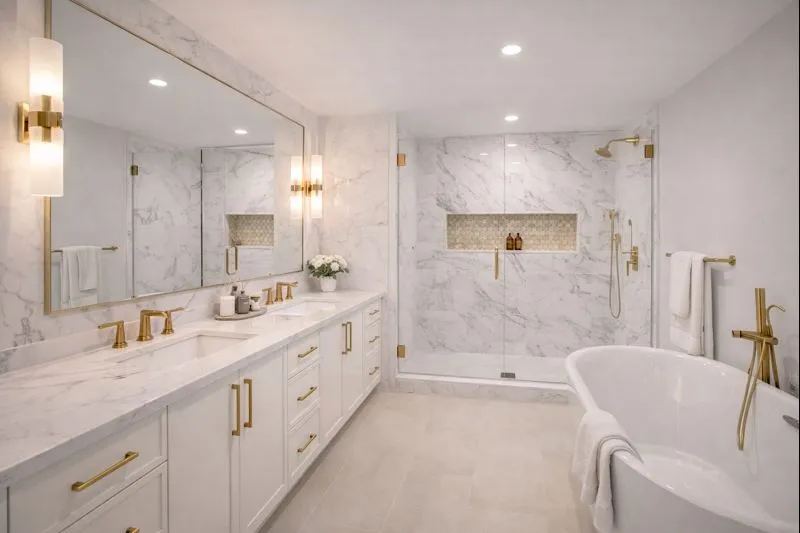
If budget is the worry, the better lever is scope, not timing. The most reliable way to keep a remodel in check is to leave the plumbing and walls where they are and route the budget into materials and fixtures. On a recent South Loop multi-bathroom remodel, we updated two dated builder-grade bathrooms by keeping both layouts in place and investing the budget in Carrara marble, a custom glass enclosure, and brass fixtures. Holding the footprint avoided the most expensive part of any bathroom remodel, which is moving water and waste lines. The same principle applies across Lincoln Park and Wicker Park: a layout-preserving remodel today usually beats a layout-changing remodel two years from now at higher prices. It is also the approach that makes a condo renovation realistic when an association limits how much plumbing you can move.
When Waiting Actually Makes Sense
Waiting is the right call in a few real situations, and it is worth being straight about them. If your savings are not where you want them, that matters. The Houzz study found 84 percent of homeowners funded 2024 projects from savings, while credit-card financing fell 8 points to 29 percent, a sign that homeowners are avoiding high-interest debt in this rate environment. Borrowing at today's rates can easily cost more than the price increase you would face by waiting a year.
Waiting can also make sense if you plan to sell within a year, since you may not recoup a major remodel quickly, though most homeowners are not in that position. The Houzz study found 61 percent plan to stay in their homes 11 or more years, and only 7 percent remodel with the intent to sell. For the majority staying put, the value of the remodel is the years you get to live in it, which is an argument for sooner rather than later. That logic holds whether you are planning a single room, a whole home renovation, a basement finishing project, or custom carpentry and built-ins that make your current space work harder.
Frequently Asked Questions
Will remodeling costs go down if I wait a year?
Probably not. National data shows median spend on major kitchen and bathroom remodels held steady or rose from 2022 through 2024, and the high end climbed every year. Materials, tariffs, and labor are all still pushing costs up heading into 2026, so waiting is more likely to raise your price than lower it.
Is 2026 a good time to remodel in Chicago?
For homeowners planning to stay in their home, yes. Costs are not expected to fall, demand is keeping good contractors booked, and Chicago's older housing stock often makes delaying riskier because deferred issues turn into damage. The main reason to wait is if your finances are not ready.
Why did the Houzz study show remodel spending drop in 2024?
The overall median dipped because more homeowners chose smaller projects that year, not because remodels got cheaper. When you look only at major remodels, median spend held flat or increased, which is the better gauge of what a full kitchen or bathroom project actually costs.
How much more does a Chicago remodel cost than the national average?
Chicago projects typically run 15 to 25 percent higher than national figures, driven by older buildings, strict local codes, and condo and HOA requirements. A major midrange kitchen remodel in the Chicago metro was estimated near $84,237 in the 2025 Cost vs. Value Report, above the national number.
What is the best way to keep a remodel affordable right now?
Keep your existing layout and put the budget into materials and fixtures. Moving plumbing and walls is the most expensive part of a kitchen or bathroom remodel, so a layout-preserving project lets you upgrade finishes meaningfully without the cost of relocating systems.
Should I remodel now if I might sell in a few years?
If you are selling within roughly a year, waiting may make sense, since you may not recoup a major remodel that quickly. If you plan to stay several years or longer, which most homeowners do, the value is in living with the upgrade, and acting sooner usually costs less than waiting.